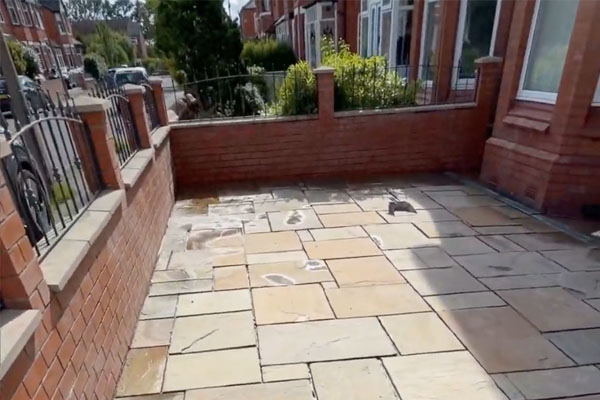
Sandstone Patio and Driveway Restoration in Heaton Chapel: When a Partial Repoint Became a Full One
Paul got in touch about his Indian sandstone. There's somewhere between 120 and 130m² of it at his place in Heaton Chapel, split between a front driveway that has cars parked on it most days and a rear patio he uses for entertaining. Both had gone grey and green, and the joints were giving up in places. This is how we restored it, including the bit nobody saw coming. If you've got tired sandstone anywhere around Stockport or south Manchester, it might save you a nasty surprise.
The brief: restore it, and match what's already there
Paul wanted the whole lot brought back to life. He was clear on one point from the start: he wanted traditional sand and cement pointing, not resin, so any repairs would match the finish he already had.
From his photos and a walk round the site, most of the existing pointing looked reasonable. So we agreed a partial restoration. Our estimate was that about 40% of the joints had failed and would need cutting out and repointing, with the rest left alone.
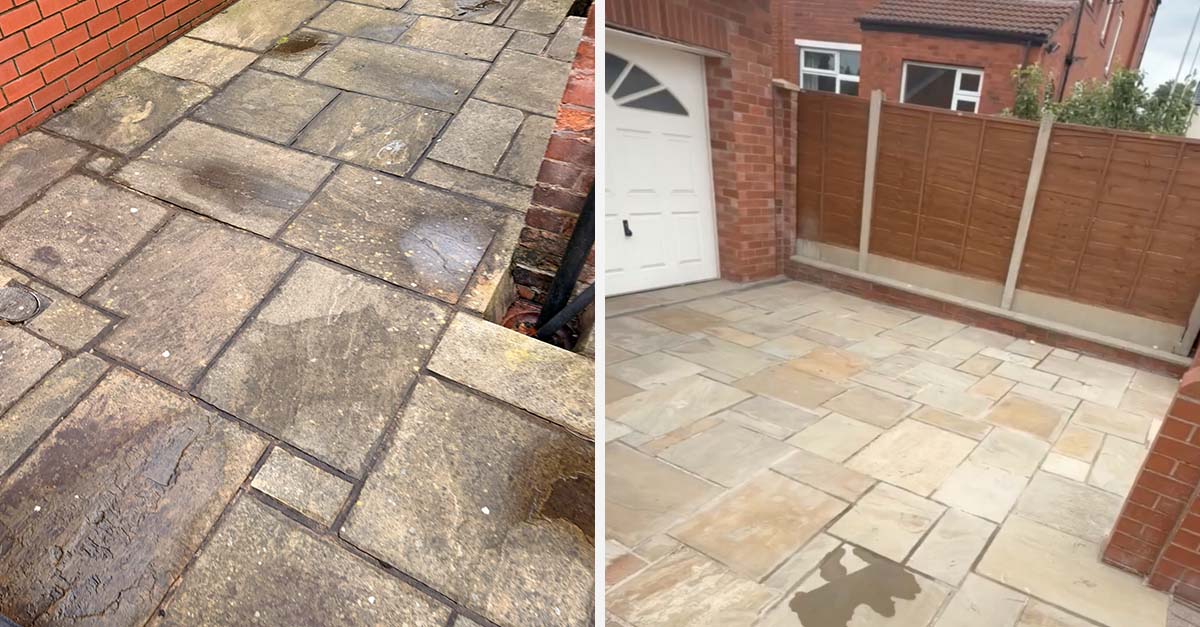
Cutting out the failed joints
We started by removing the failed sand and cement joints with grinders and hand tools. It's slow, dusty work, but there's no shortcut. New mortar needs enough depth to grip properly and carry weight, so you have to take the old stuff out properly rather than just filling over the top.
What the pressure washer showed us
Once the failed joints were out, we pressure washed the whole driveway and patio. That was always the plan. What we didn't expect was what came off with the dirt.
A previous contractor had repaired a lot of the joints, but only very shallowly, often about 5mm deep. On the first survey those patches looked fine. As the washing cleared the grime and loose material, they started letting go from the edges of the slabs and failing completely. Patches that had been sitting there looking like sound pointing were just a thin skin of mortar.
You can't spot that by looking, and a survey can't find it. It only shows once the surface is properly cleaned.
Stopping to call Paul
We could have pointed over the top and stuck to the original quote. It would have looked fine on the day, but it would have been another thin repair sitting on top of the last one.
Instead we stopped and rang Paul. We told him what we'd found, showed him what had lifted and talked through the options before doing anything else. He asked us to put all of it right. That took the job from about 40% of the jointing to nearer 90%.
We'd rather have that conversation than a patio that needs doing again. Paul was straightforward about it, and the clear communication kept the job on track.
Black spot and green growth
With the joints dealt with, we applied a chemical treatment across the sandstone to deal with the black spot and organic growth. Sandstone holds on to it stubbornly. The pressure wash lifts the worst, and the treatment finishes the job, so the stone goes back to looking like stone rather than a patch of dark speckles.
Rain, and pointing in stages
We worked in stages: joints out, wash and treat, then repoint. Rain delayed part of the programme, so we adjusted the pointing schedule to suit.
For the pointing itself we used traditional sand and cement mortar, pushed firmly into the joints and finished by hand. Compacting it properly matters as much as the mix. A joint that's only filled on the surface will crumble from the edges first, which is exactly what we'd just seen with the old repairs.
Why sand and cement rather than resin on this job
Paul asked for it, and it made sense. The existing pointing was sand and cement, and matching it keeps the repaired areas from standing out against the old. Resin is a good option in the right place (we used it on a brand new patio not far from here, in a separate job), but when you're repairing an existing traditional finish, matching what's there usually looks best.
The extras: railings, fence panels and the shed
Once the patio and driveway were finished, Paul asked us to tidy up the rest. We sprayed the front metal railings, the front fence panels and the visible sides of his garden shed in a modern grey. It pulls the whole front and back together, and it made sense to do it while we were already on site and the paving was freshly cleaned.
The result
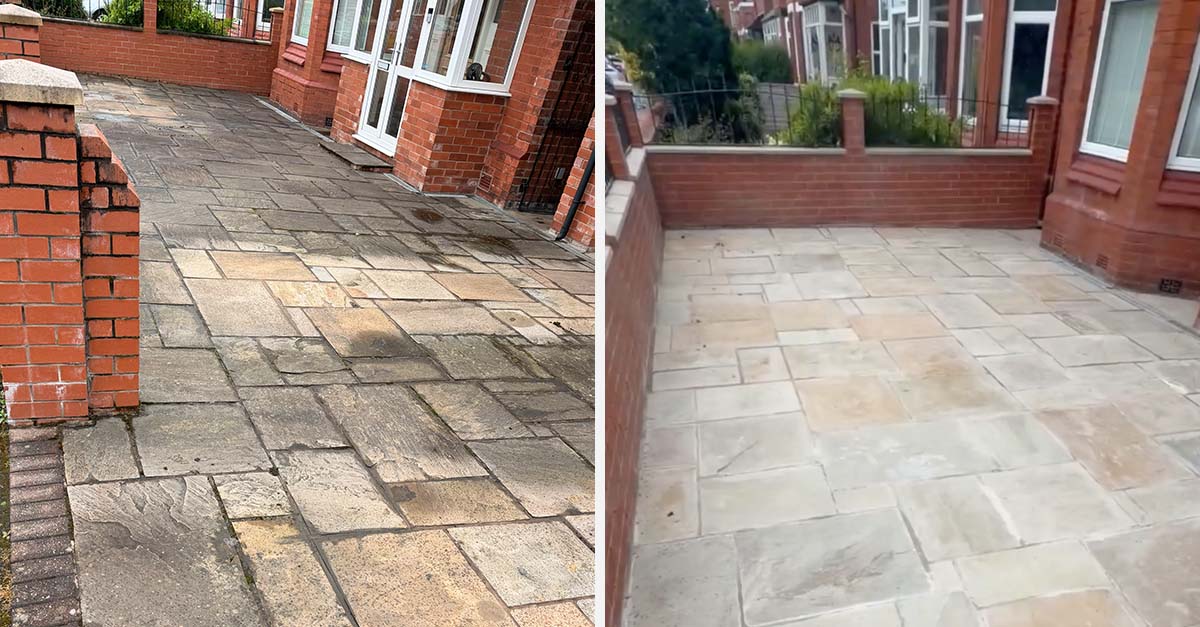
Roughly 120 to 130m² of Indian sandstone restored
Around 90% of the jointing renewed
Black spot and organic staining removed
A traditional sand and cement finish that matches the existing paving
Railings, fence panels and shed sprayed in a modern grey
Paul left us an excellent review afterwards. [Add Paul's review wording here if we can get it]
Thinking about sandstone patio restoration in Stockport?
If your patio or driveway has gone green and the joints are crumbling, the honest answer is that we can't tell you exactly how much work it needs until we've seen it, and sometimes not until it's been washed. We price after a site visit, and if the washing shows up more than we expected, we stop and talk it through with you before carrying on. No surprise bills.
We cover Heaton Chapel, Heaton Moor, Heaton Norris, Reddish, Edgeley, Cheadle, Didsbury and the rest of Stockport and south Manchester.
[Book a site visit on WhatsApp]
FAQs
Why did a partial patio repair turn into a near full restoration? Because the true condition of the old pointing didn't show until the patio had been pressure washed. Earlier repairs were only about 5mm deep and came away from the slab edges as the dirt cleared. Covering them over would have been a quick fix that failed again, so we recommended doing it properly.
How deep should patio joints be cut out before repointing? Deep enough for the new mortar to bond to the sides of the slabs and hold its shape. Very shallow patches, like the 5mm repairs we found here, are a common reason pointing lifts. We cut failed joints out to a proper depth every time.
Is sand and cement or resin better for repointing a patio? It depends on the paving and what's already down. Resin is hard-wearing and quick. Sand and cement gives a traditional finish and is the best match when your existing pointing is sand and cement, which is why Paul chose it. We'll recommend the right one when we see the site.
Can you remove black spot and green growth from Indian sandstone? Yes. We pressure wash the whole surface and then apply a chemical treatment to remove black spot and organic growth. Doing this before repointing means the new joints go into clean, prepared stone.
How much does patio or driveway restoration cost in Stockport? It depends on the size, the condition of the joints and how much needs cutting out, so we price after a site visit. If the extent of the failed pointing only becomes clear once we've washed the surface, we'll show you and agree the next step before continuing.
Do you spray fences, railings and sheds? Yes. On this job we sprayed the front railings, fence panels and the visible sides of the shed in a modern grey once the patio work was done. It's a good add-on when we're already on site.


